Texas Joe’s / London, TexasVol. I / 2016
Big Smoke Signal

Stories worth keeping.

Three writers. A whole lot of Texas barbecue history.

Originally published in Texas Joe’s Big Smoke Signal in 2016. These are historical pieces, presented with their original bylines. References to dates and events belong to that edition.

A Historical Overview of BBQ’s “Other” Meats

From the original Smoke Signal menu art

Lamb/Mutton

Last Father’s Day, I spent the morning watching the men of Millheim Harmonie Verein Hall baste and flip barbecue on large open pits. There were beef clods, pork shoulders, and whole mutton. That last one is something you don’t often see on barbecue joint menus in Texas, whole or not, but back in the days before barbecue restaurants it was nearly as ubiquitous on the pit as beef and pork.

In 1860, a journalist in Corsicana for the Navarro Express wrote a brief report on barbecue cooked by W.A. Lockhart. They described a table that “was well supplied with fish, flesh and fowl. That barbecued mutton did not go begging, and the man who barbecued the meats is evidently master of the art.”

One reason mutton was more regularly featured at this community picnics of yore came down to convenience. Smoking whole pigs, goats, and sheep was more physically manageable than smoking an entire steer. It was only when meat markets—whose business model was to break down whole animals into smaller cuts—started serving barbecue that beef superseded lamb and mutton in Texas barbecue.

Because American menus feature these proteins less often, many people are confused about the difference between mutton and lamb. The former is meat from a sheep that is older than a year. Lamb is younger, usually slaughtered at less than six months old. (You might also see the term “hoggett,” which is used outside the US as a way to describe animals between one and two years old.) Lamb has a distinct flavor, but it’s still quite a bit milder than the much gamier mutton.

Just because mutton comes from an older animal doesn’t make the meat any lesser than lamb, but given its flavor, one many palates are unaccustomed to, it’s not served nearly as often. At many places in Texas, even when a restaurant says its serving mutton, they’re probably dishing out lamb. That’s the case at Southside Market in Elgin (and Bastrop), where the “mutton” is actually lamb ribs (technically lamb breast). Owner Bryan Bracewell says it’s to keep the old-timers who still order it happy. They come for mutton, so Southside gives them MINO—Mutton In Name Only.

Even though smoked lamb and mutton have a long history in Texas, it’s hard to trace. The U.S. raises less than half the sheep we did even twenty years ago. The wool industry, which once flourished in Texas, is now dominated by New Zealand and Australia, and because wool-producing sheep are the main source of mutton on the market, less wool means less mutton. A Modern Farmer article from 2013 noted that “We’ve long exported live ewes through San Angelo, Texas (the country’s largest sheep and lamb auction) to Mexico for barbacoa de borrego.” Because lamb production is down, so is consumption. An article from Harvest Public Media noted that in the sixties we ate 4.5 pounds of lamb every year. Today, according to the USDA, Americans eat less than a pound of lamb every year.

(I think there’s still plenty of room for more lamb on barbecue menus. It brings back a flavor of Texas’s barbecue past that is unique and succulent. Lamb, and especially mutton, might bring a taste that needs some acquiring, but it’s worth the effort.)

The Pork Sparerib

Memphis has the baby back rib. Chicago has rib tips. St. Louis even has a style of ribs named after its fair city. But spareribs are what you’ll get in Texas when “ribs” alone are listed on the menu. For the most part, we find baby backs too dainty, Chicago-style too wanting, and St. Louis-style too willing to waste a perfectly delicious tip (the meaty nub attached to the end of a sparerib).

How did spareribs capture our state’s attention and tastebuds? Well, that’s just the way it’s always been. If you go back far enough, that might not always hold true (whole hogs were common in community barbecues, so those ribs weren’t served separately), but as long as we’ve been cutting up hogs before cooking them, the sparerib has been popular. (Also, there are variations on how spareribs is spelled. We’ve decided to adopt the single word.) There are mentions of the sparerib in both the San Antonio Texan and Galveston Weekly News in 1855. In 1870, a recipe for sparerib pie appeared in the Fort Worth Daily Gazette with detailed instructions that still somehow managed to leave out what to do with the bones.

Yet rather than being a regular item at the meat market, the sparerib was more of a cult classic. It was associated with wintertime cooking when it was hog killing time. When the animal was slaughtered, the meat had to be cured, confited, ground into sausage, or eaten right away. Cuts like hams and bellies were sent to the smokehouse where patience was a requirement, but spareribs were typically enjoyed immediately. Think of them as a hog slaughterer’s treat. Once the belly was removed, the ribs beneath it were considered leftovers to that cut (hence “spare ribs”). There wasn’t much you could do with the leftover spareribs but cook them and enjoy the scant meat between the bones. Great sparerib feasts would be enjoyed when farmers came together to slaughter their hogs for the winter.

The sparerib’s appearance on barbecue menus dates back around the turn of the century, when selling barbecue in meat markets and restaurants became the norm, and, just like with smoked brisket’s history, El Paso led the trend. In 1898, an ad in the El Paso Daily Herald included spareribs along with other “barbacued [sic] meats” at New Market. Melvin Meat Co., also in El Paso, advertised their smoked spareribs in 1911 and in 1917. Elsewhere in El Paso, pitmaster I. Stern was cooking “barbecued spare ribs” as well as “any kind of meat you want, cooked to a delicious brown in our barbecue pits.”

Spareribs had taken hold on menus across Texas, but they weren’t meant for polite company. To get at the meat, a knife and fork wouldn’t suffice. Getting the most out of a sparerib meant manhandling the meat. In 1920 the Dallas Morning News noted that “No one can properly appreciate spareribs and backbones unless courageous enough to get his chin and cheeks greasy.” A letter was even sent to Emily Post asking about sparerib etiquette. She responded that unless you were at a picnic, “you must not pick up spareribs in your fingers,” and further advised to use a steak knife. Maybe she’d never eaten a sparerib.

It didn’t much matter to meat market and barbecue joint patrons who weren’t sitting down to white tablecloths and linen napkins. They enjoyed all sorts of hard-to-eat cuts at places like Lowry’s Grocery, Market & Deli in Breckinridge, Texas, where you could enjoy “Barbecued pork ears, snouts, tails, feet, and spare ribs,” in 1929. The dish was also frequently associated with drinking. Just after the repeal of Prohibition in 1933, the Fort Worth Star-Telegram noted that “Barbecued ribs, always popular in West Texas, have grown increasingly so with the advent of beer, ranchmen say. A group of Midland cattlemen had a barbecue and a keg a few hours after the keg’s contents were legalized.”

Even with these new and tempting cuts of ribs, spareribs have remained the primary choice for pork ribs at Texas barbecue joints. Even when baby backs are offered, it’s usually alongside their big brother. I personally think spareribs are the perfect cut. They’re meaty with plenty of fat, and the attached rib tips make for a nice treat of meat and fat if you’re willing to work for it. That, and they’re cheaper that baby backs or St. Louis ribs. Maybe they’re not so spare after all.
First published in Big Smoke Signal, Volume I, 2016, pages 1 and 4. View the original newspaper ↗ · Back to the contents ↑

In Postwar England, Texas Barbecue to the Rescue

Big Smoke Signal masthead with London and a cowboy
London, Texas / Volume I

The year was 1952. England still was reeling from shortages of food and other materials after World War II. Industry and agriculture had been decimated and postwar production was slow to resume. The British government continued the centrally planned economic policies it had imposed during the war effort, including rationing of foodstuffs such as bread, sugar and meat.

This posed a problem for Sir William Spens, master of Corpus Christi College, one of the colleges that makes up Cambridge University. Spens was tasked with planning the college’s 600th birthday celebration. A thousand current students and alumni would attend. How to feed them all?

And this being England, there was tradition to uphold. Records from the founding in 1352 described the roasting of a whole ox on a spit turned over an open fire. How could this be duplicated under the current rationing system, when there was barely enough meat for one person, much less a thousand?

The government notified the college they could have a whole steer, but it would have to be deducted, pound for pound, from the school’s future meat ration. In effect, Corpus Christi College wouldn’t see any more meat for years to come (as it turns out, meat rationing would end in 1954).

Word of the school’s conundrum reached Dan Chamberlin, manager of the Chamber of Commerce in Corpus Christi, Texas. Like any enterprising city official whose job it is to both promote his city and do good deeds, Chamberlin saw a public relations opportunity.

He contacted the British consul general in Houston, J. Thyne Henderson, and offered to send a whole Texas Longhorn steer to the city’s namesake college in England.

Sir Spens and college dean John Harley Mason sent a cable back accepting the offer. But there was one problem: They had been under rationing for so long, no one there knew how to cook a whole steer.

And that’s when an otherwise obscure insurance salesman from Texas named Buster Shely gained his 15 minutes of fame as the “Official Ambassador of Barbecue” to Great Britain. Shely was active in his local Corpus Christi Lions Club chapter and had become known for cooking at club functions.

Chamberlin went back to work. Not only would his city send a whole steer to England, they would also send a “barbecue expert” to cook it for them. Chamberlin tapped Shely for the job. Funds were collected from the Chamber of Commerce, Lions Club and a local businessman to pay for the trip.

The only snag was Shely didn’t have a passport. Calls were made to Congressional Representative John Lyle and then Senator Lyndon Johnson to expedite the process. On June 15, 1952, Shely boarded an Eastern Airlines plane for Washington, D.C. where he would pick up a passport on the spot.

Armed with the meat of a 1,000 pound Texas Longhorn steer, a Corpus Christi city flag, a yellow shirt with “TEXAS” embroidered on the back, a bottle of Tabasco sauce and some chili powder, Shely flew on to England the next day.

In a remarkable Movietone newsreel, Shely is shown cooking the steer on a traditional trench barbecue pit filled with coals and covered in chicken wire. By all accounts, the college celebration was a success. Students and alumni formed an orderly queue 40 yards long to receive a small roll of bread stuffed with Texas barbecue beef and covered in Shely’s chili powder and Tabasco sauce. (English beer was served to soften the heat of the sauce, which most guests had never experienced before.)

“All in all,” Shely told the Corpus Christi Caller Times, “it went off right good. Only trouble is I had to use elm wood for the fires instead of mesquite wood like back home.”

A band from the 4th Queen’s Own Hussars – Winston Churchill had been a commissioned officer in the military regiment – asked Shely what song he’d like played during the celebration. He replied “The Eyes of Texas,” but the band wasn’t familiar with the music. So, like any good ambassador, he compromised “The Roast Beef of Old England” followed by “The Stars and Stripes Forever.”

Back in Texas a few days later, Dan Chamberlin got another cable from England. Sir William Spens wrote: “Barbecue made best party in 600 years. More than grateful.”

First published in Big Smoke Signal, Volume I, 2016, pages 1 and 4. View the original newspaper ↗ · Back to the contents ↑

Concise History of Texas Barbecue

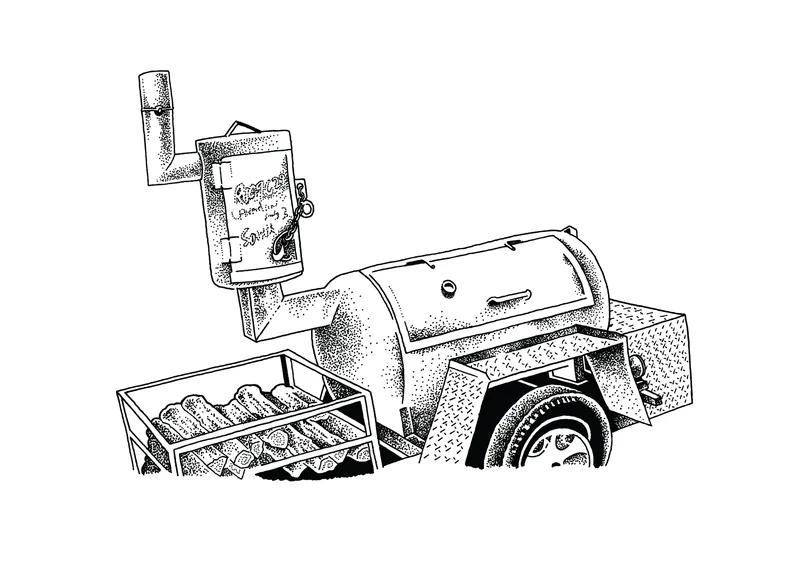
Original Smoke Signal wood-fired smoker illustration
Smoke, meat and time

The first barbecues in Texas were religious experiences. The earliest mention of Texas barbecue in the English language comes from an 1832 handbill advertising an East Texas revival meeting, where free barbecue was handed out to all comers. Barbecue was the main attraction at Protestant religious rallies held on the wild frontier. The pioneers didn’t have any churches, so beginning in the late 1700s, itinerant preachers held “camp meetings” to spread religion across west.

The most successful preachers tended to be highly skilled pitmasters.

The “open pit” style of Southern barbecue featured hundreds of pounds of meat cooked over hot coals in long three foot deep trenches. Whole hog was the most popular meat in Kentucky and Tennessee, but sheep and goats were more common in Texas. Of course, by the 1700s, Spanish cowboys on ranches in South Texas were already cooking beef “barbacoa” in pozos, earthen ovens lined with rocks, a technique they learned from the native tribes of Texas.

But this tender, steamed meat didn’t have any of the smoky flavor we now associate with barbecue. The Old World meat smoking brought to Central Texas by German and Czech butchers in the mid 1800s greatly influenced the Texas barbecue style. German meat markets sold fresh meats and smoked their leftovers in enclosed smokers, as they had done in the Old Country.

The smoked meat was especially popular with cotton pickers, the migrant farm workers who took over the strenuous task of bringing in the cotton crop after slavery was abolished.

There were more than half a million of them roaming the state during the picking season and they weren’t allowed to eat in restaurants. Which explains why you find great Texas barbecue in convenience stores, gas stations and butcher shops. Texas also departed from the Southern whole hog tradition after the Civil War. During the great cattle drives of the 1880s, beef was incredibly cheap in Texas, and it became the meat most characteristic of Texas barbecue.

Because you could feed so many people with a whole steer, cowboy barbecues started out big – and got bigger. The cowboy barbecue tradition lives on in such events as the XIT Rodeo and Reunion in Dalhart where tens of thousands of people gather each year to attend the “world’s largest free barbecue.”

First published in Big Smoke Signal, Volume I, 2016, pages 1 and 4. View the original newspaper ↗ · Back to the contents ↑